
IV. Small Crown Watermark
IV. Small Crown Watermark. An asymmetrical top-view representation of the crown.
Read →
IV. Small Crown Watermark. An asymmetrical top-view representation of the crown.
Read →
IX. Free-Standing Double-Cross Watermark. Regularly repeating upright and inverted double crosses, together with double crosses lying to the left and right.
Read →
Stamp sheets are normally perforated so that the stamps can be separated easily. Stamps without perforations along their edges are described as imperforate or unperforat…
Read →
Ink show-through occurs when the printing ink gradually penetrates the paper and becomes visible on the reverse of the stamp.
Read →
An inverted print is a rare and striking error in multistage printing. It occurs when the sheet is inserted into the press upside down during one printing phase, causing…
Read →
Relief printing was widely used in the early production of postage stamps and is usually referred to as letterpress in philately. The raised parts of the printing surfac…
Read →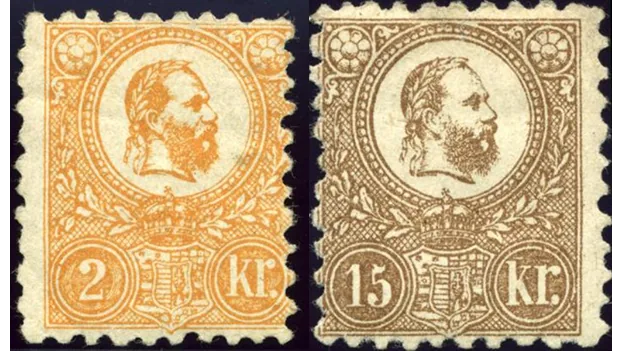
Lithography is the oldest and simplest form of planographic printing. The process is based on the principle that grease and water repel one another.
Read →
In Hungarian philately, the term tévnyomat refers to stamps that were produced in a form contrary to the postal administration’s intention, nevertheless entered postal c…
Read →
A miniature sheet is a stamp sheet smaller than a normal postal sheet and may contain one or more stamp designs, sometimes together with labels or tabs. It usually conta…
Read →
A mint hinged stamp is an unused stamp with a stamp hinge still attached to the reverse or with a visible hinge trace on the original gum.
Read →
In Hungarian philately, postatiszta is a condition term corresponding to the internationally used expression mint never hinged (MNH).
Read →
In multistage or multicolour printing, one of the printing phases may occasionally be omitted, causing one or more colours to be missing from the stamp.
Read →