
Relief printing was widely used in the early production of postage stamps and is usually referred to as letterpress in philately. The term comes from the same printing principle used for books since the time of Gutenberg. The raised parts of the printing surface carry the ink and transfer it to the paper.
Traditional typesetting plays only a secondary role in stamp production because stamp designs normally contain pictorial elements as well as inscriptions and numerals. The printing surface is therefore generally produced by engraving or reproduction processes. Movable type was mainly used for later-added denominations, overprints and inscriptions or numerals in sheet margins.

In relief printing, the parts of the printing die that form the design project above the surrounding surface. These raised elements receive the ink and transfer it to the paper under pressure. Printing plates may be assembled from duplicated dies made from the original engraving by processes such as stereotyping, electroforming or electrotyping. The printing surface may be flat, curved or cylindrical.
To obtain an even impression, the inked printing surface must make accurate contact with the paper. Letterpress is characterised by sharp outlines, while the pressure may force a small amount of ink toward the edges of printed lines. With a strong impression, the paper may also show slight embossing toward the reverse.
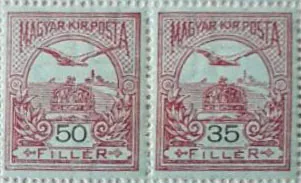
Letterpress was used alongside lithography for Hungary’s first newspaper stamp issue of 1871. It was later employed for many values of major definitive series, including the Black-Numeral Krajcár, Turul, Harvester–Parliament, Official and Pengő–Fillér issues, as well as for numerous overprints. By the end of the 1920s, letterpress had effectively disappeared from Hungarian stamp production.
