
VI. 1909 front-view crown watermark.
The crown motif is shown from the front, similarly to the preceding watermark. The complete design was small enough to fit within a Turul-design stamp and was repeated at intervals that could, in principle, have placed one complete crown on each stamp.
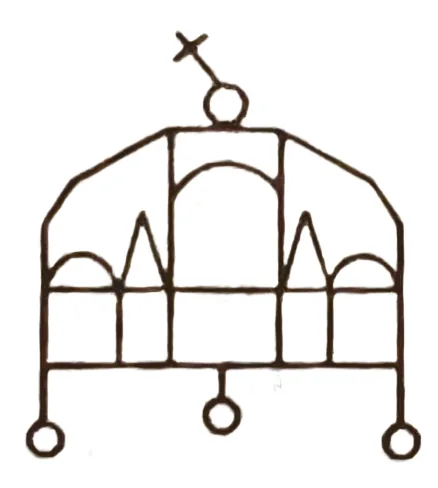
Here too, it is unusual for a complete crown to appear on a single stamp; normally, parts of two or more motifs are visible. On postage and newspaper stamps the watermark occurs upright, while on postage-due stamps it occurs sideways, with four possible positions in each orientation. The orientation can be determined on every stamp, but the exact position can be established only on examples where the cross on the crown is visible. The original production orientation of the watermark was heraldically correct.
Watermark orientations and positions
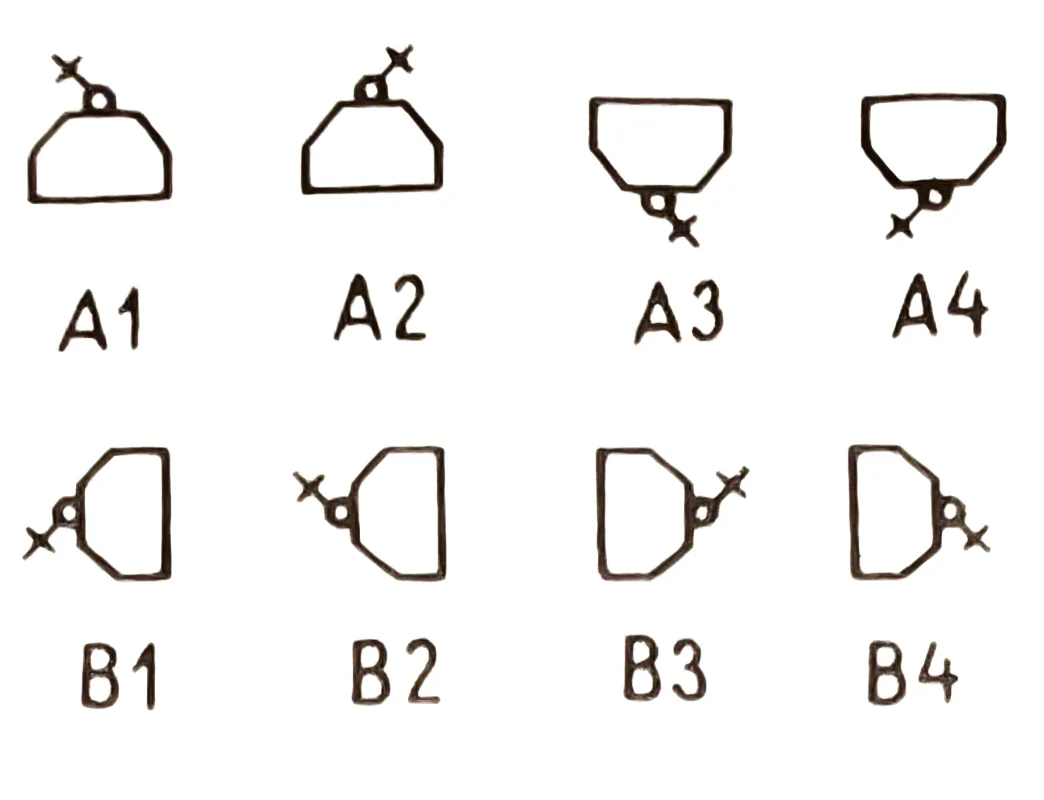
- A1: upright crown, with the cross leaning to the left;
- A2: upright crown, with the cross leaning to the right;
- A3: inverted crown, with the cross leaning to the left;
- A4: inverted crown, with the cross leaning to the right;
- B1: crown lying to the left, with the cross leaning to the left;
- B2: crown lying to the left, with the cross leaning to the right;
- B3: crown lying to the right, with the cross leaning to the left;
- B4: crown lying to the right, with the cross leaning to the right.
Issues on which the watermark occurs
1909 Turul, 1909 Newspaper Stamp, 1909 Green Postage Due.
Distinguishing Watermarks V and VI

- The angle of the cross on the crown: on Watermark V it is approximately 30 degrees or less, while on Watermark VI it is consistently about 50 degrees.
- The base of the cross appears as a blurred circular spot on Watermark V, whereas on Watermark VI it is usually a regular circle.
- The upper line of the crown is generally more curved on Watermark V, while on Watermark VI it is usually more angular.
- The outer divisions of the brow band are generally of equal width on Watermark V, whereas on Watermark VI the inner divisions are usually narrower.