

A major error regarded by stamp collectors as one of philately’s Holy Grails. It is easy to see why: 105 years ago a collector bought a sheet of 100 for $24, while today individual examples have sold for nearly $1.6 million.
The Inverted Jenny, also known as the Upside Down Jenny or Jenny Invert, is a 24-cent United States postage stamp issued on 10 May 1918, with the Curtiss JN-4 aircraft printed upside down in the centre. It is one of the most famous errors in American philately. Only a single sheet of 100 stamps with the inverted centre was produced.
Background
During the 1910s, the United States Post Office conducted several experiments with carrying mail by air. It eventually decided to launch its first scheduled airmail service between Washington, D.C., Philadelphia and New York City on 15 May 1918. A rate of 24 cents was set for the service, far above the 3-cent rate for ordinary first-class mail at the time, so a new stamp was commissioned. Printed in patriotic red and blue, the stamp depicted a biplane Curtiss Jenny JN-4HM specially modified for carrying mail. Its designer, Clair Aubrey Houston, even had difficulty obtaining a photograph of the modified aircraft, but the aircraft shown on the stamp was indeed the one that took off from Washington on the inaugural flight at 11:47 on 15 May 1918.

The new stamp was designed and produced in great haste: engraving began only on 4 May and printing on Friday, 10 May. The 2.1 million stamps were printed in sheets of 100. Because the stamp was printed in two colours, each sheet had to pass through the press twice, creating an obvious opportunity for error; the same process had already produced inverted elements on United States stamps of 1869 and 1901. Contemporary accounts state that at least three incorrectly printed sheets were discovered and destroyed during production. On one defective sheet, however, the inverted centre went unnoticed and the sheet entered circulation.
How the Error Entered Circulation
The first stamps reached post offices on Monday, 13 May. Aware that an inverted print was possible, a number of collectors visited local post offices to buy the new stamps and look for errors. On 14 May, William T. Robey did the same. When the postal clerk brought out a sheet, Robey spotted the inverted centre and, by his own account, his heart nearly stopped. Concealing his excitement, he bought the sheet. The clerk who sold it later said he had not noticed that the aircraft was upside down because he had never seen an aeroplane before.
Robey then contacted stamp dealers and journalists to tell them about his remarkable find. Postal inspectors soon visited him and tried to buy back the defective sheet, which he had hidden under his mattress. Eventually, Robey sold the sheet he had bought for $24 for $15,000 to the prominent Philadelphia dealer Eugene Klein. Klein advertised the sheet and then sold it intact to Colonel Edward Green for $20,000, making only a modest profit.
Colonel Green broke up the sheet of 100 and sold the stamps individually and in blocks of four at steadily rising prices. One Inverted Jenny was auctioned for the benefit of the Red Cross in support of the war effort. Green had another example mounted in a pendant for his wife. One side of the gold-and-glass pendant displayed the Inverted Jenny and the other a normal Jenny stamp.
According to philatelic literature, seven of the stamps have been lost or stolen. Several others were damaged through poor handling; one even ended up in a vacuum cleaner.
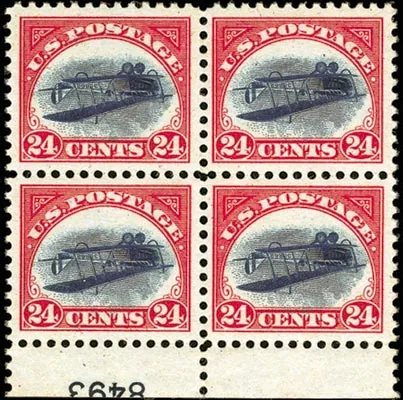
The Inverted Jenny Today
The appearance of an Inverted Jenny at auction remains a major event. In November 2007, a mint never hinged example sold for $977,500. According to the broker involved in the sale, the buyer was a leading Wall Street figure. In October 2005, at a Robert A. Siegel auction, a block of four Inverted Jennys sold for $2.7 million. Prices fell during the 2008 financial crisis. Between January and September 2014, five examples offered at auction sold for between $126,000 and $575,100. Prices later recovered: on 31 May 2016, a particularly well-centred Inverted Jenny sold at auction for a hammer price of $1,175,000. On 15 November 2018, Robert A. Siegel Auction Galleries sold the recently discovered position 49 example for a new record hammer price of $1,350,000; with the buyer’s 18 per cent premium, the total cost reached $1,593,000 .
On 12 January 2008, StampWants.com awarded an Inverted Jenny at the end of a year-long promotion. It was the most valuable stamp ever given away in such a promotion. The winner was John Shedlock of California, and the stamp was presented to him by the then Miss New Jersey, Amy Polumbo.