
Interlaced ellipses with the lowercase letters “kr” in the centre, an abbreviation of krajcár.
Watermark I – Nagyszlabos

Interlaced ellipses with the lowercase letters “kr” in the centre, an abbreviation of krajcár. The ellipses measure 36–37 × 32–33 mm; the letter “k” is approximately 13 mm high and the “r” 9 mm. On stamps the watermark occurs only sideways, in four possible positions. The position can be determined from either letter or from a sufficiently characteristic part of it.
Possible watermark orientation and positions
| B1 – “kr” lying to the left |  |
| B2 – mirrored “kr” lying to the left |  |
| B3 – “kr” lying to the right |  |
| B4 – mirrored “kr” lying to the right |  |
Issues on which the watermark occurs
1881 Coloured-Numeral Krajcár Issue, Plate I; 1881 Newspaper Stamp.
Watermark Ia – Fiume
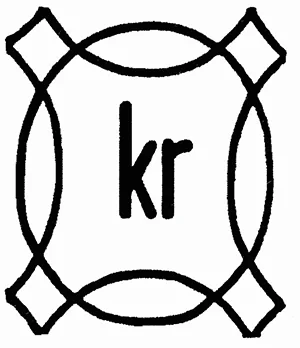
The design is similar to Watermark I but differs in size. The ellipses measure 36–39 × 32–33 mm; the letter “k” is 13–15 mm high and the “r” 9–10 mm. On postage stamps it occurs only sideways, while on newspaper tax stamps it also occurs, though rarely, upright. Four positions are possible in each orientation. The position can be determined from either letter or from a sufficiently characteristic part of it.
| A1 – upright “kr” |  |
| A2 – upright mirrored “kr” |  |
| A3 – inverted “kr” |  |
| A4 – inverted mirrored “kr” |  |
| B1 – “kr” lying to the left | |
| B2 – mirrored “kr” lying to the left | |
| B3 – “kr” lying to the right | |
| B4 – mirrored “kr” lying to the right | |
Issues on which the watermark occurs
1881 Coloured-Numeral Krajcár Issue, Plate I; 1881 Coloured-Numeral Krajcár Issue, Plate II; 1881 Newspaper Stamp; 1888 Black-Numeral Krajcár Issue; 1889 Newspaper Tax Stamp.
Distinguishing Watermarks I and Ia
The difference in size between Watermarks I and Ia is explained by the postal administration’s practice of tendering the paper supply every three years. In 1887 the contract passed from the Nagyszlabos paper mill, which had supplied the paper until then, to the Fiume mill. Its machine was narrower, so the existing dandy roll could not be used and a new one had to be made.
Watermarks I and Ia can be distinguished from the complete design, or at least from complete examples of the letters “k” and “r”. In most cases, reliable identification is therefore possible only on joined stamps or blocks. In certain cases, however, individual stamps can also be identified with certainty. Examples cancelled before 1887, as well as stamps with close or mixed perforation, bear Watermark I; examples with a “k” measuring 14–15 mm in height bear Watermark Ia.
The Nagyszlabos watermark has a further distinctive feature. The watermarking dandy roll was a cylinder approximately two metres long. The ellipses forming the watermark, together with the letters inside them, were soldered in rows onto its wire mesh. When the rows of ellipses were fitted around the circumference of the cylinder, the lens-shaped intersections in the final row did not meet the square-shaped intersections of the first row, leaving a gap 1–3 mm wide along the entire length of the cylinder. The two types of intersection were also somewhat offset sideways. A straight wire was soldered into this strip along the whole length of the cylinder. This straight line between the mismatched intersections occurs only on stamps printed on paper made at Nagyszlabos.
The ellipses themselves were assembled from separate pieces soldered together at the intersections. During use, individual pieces sometimes became detached from the mesh, particularly along one side of the lens-shaped intersections. More rarely, letters or parts of letters also became detached. Soldered elements could first become loose and bend out of position, and some watermark elements—especially around the letters—could also become clogged.