
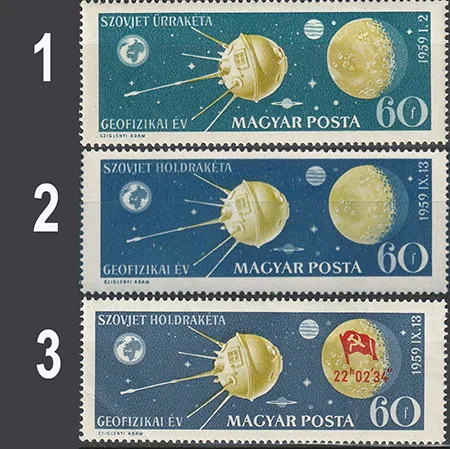
Like the Nagymánya error, the stamps shown above have caused plenty of confusion. When collectors see an image of a valuable error, their eyes often light up in the hope that the same stamp may be hiding in their own album. To clear up the confusion, let us look at the story of these three stamps so they will be easier to identify.
The International Geophysical Year ran from 1 July 1957 to 31 December 1958 and was a globally coordinated international programme of scientific observation. Its aim was to collect as much data as possible during a period of peak solar activity and integrate it with existing geophysical and other observations. The cooperation covered ionospheric research, geomagnetism, cosmic radiation and aurora studies, high-precision measurements of latitude and longitude, and projects in gravitation, meteorology, oceanography and seismology. To mark the event, the Hungarian Post issued a set of seven stamps.

As can be seen, the 60-fillér value of this set bears the inscription “SZOVJET ŰRRAKÉTA” (“Soviet Space Rocket”). The issue was printed in 600,000 sets and is therefore not rare. A complete mint never hinged set of seven can be bought for around 100–150 forints, while the individual 60-fillér stamp costs only about 20–30 forints even in MNH condition.
On 13 September 1959, the second space probe of the Luna programme reached the surface of the Moon. The spherical Luna 2, 5.2 metres long, 2.4 m in diameter and weighing 390.2 kilograms, reached the Moon after a 33.5-hour flight. The scientists had originally planned a soft landing, but the mission ended in an impact; nevertheless, Luna 2 became the first human-made object to reach the surface of another celestial body. To commemorate this major achievement of Soviet space science, the Hungarian Post issued a single stamp.

The stamp used the same basic design as the 60-fillér value of the 1959 Geophysical Year issue, but with a new “SZOVJET HOLDRAKÉTA” (“Soviet Moon Rocket”) inscription in the upper-left corner. The date at right was changed to 1959.IX.13, and in red the design showed a Soviet flag on the Moon together with the impact time, 22h 02' 23" (Hungarian time). Five million examples were printed, so this stamp is also not rare. A fine mint never hinged example can be bought for around 20–30 forints.
The error:
An error occurred during printing. One sheet, comprising 30 stamps, entered the philatelic market without the red printing phase. Thus the stamp shown below is the genuine rarity.

The Catalogue of Hungarian Stamps gives it a value of 700,000 forints. Its actual market value is difficult to determine because the stamp is offered for sale so rarely, but a figure around catalogue value is plausible.
Imperforate examples without the red printing phase are also known and are even rarer. The imperforate examples surfaced much later and were probably smuggled out of the printing works as unfinished sheets. Their market value now comfortably exceeds one million forints.

To sum up:
- A stamp inscribed “SZOVJET ŰRRAKÉTA” is not worth hundreds of thousands of forints. (20–30 Ft)
- A stamp inscribed “SZOVJET HOLDRAKÉTA” that also shows the Soviet flag and the time 22h 02' 23" in red is likewise not worth hundreds of thousands. (20–30 Ft)
- A stamp inscribed “SZOVJET HOLDRAKÉTA” with no red printing at all is the true rarity and is worth a great deal!