
On 6 May 1840, postal history reached a major milestone when the world’s first officially issued postage stamp, the Penny Black, entered use in the United Kingdom. This tiny piece of paper revolutionised communication and opened a new era in postal services.
 |
The significance of the Penny Black
At the time it was customary for the recipient to pay the postage, which was calculated according to the size of the item and the distance travelled. Recipients often refused delivery, however, making the system expensive and unpredictable. The Penny Black was the first stamp to allow senders to prepay postage at a uniform rate regardless of distance. Its one-penny face value made letter writing accessible to a far wider section of society, whereas it had previously been largely a privilege of the wealthy. The stamp was released on 1 May 1840 but was officially valid for use only from 6 May. A total of 68,808,000 Penny Blacks were issued. One stamp paid for delivery of a letter weighing one ounce, stated here as 14 grams, regardless of distance.
Design and characteristics
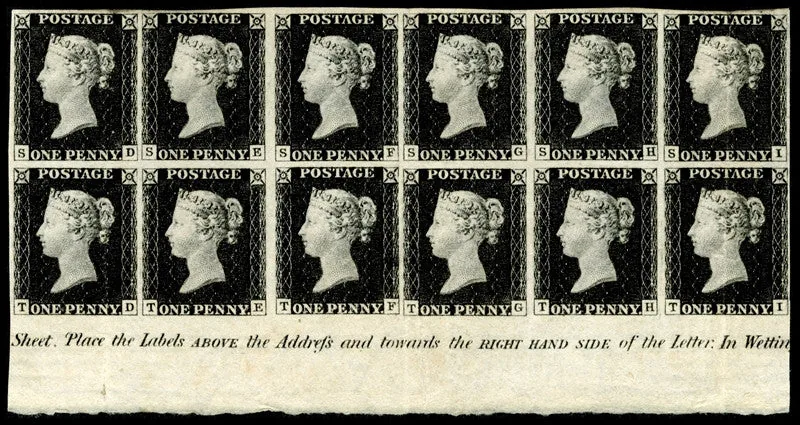
The design was simple but elegant. Printed in black, the stamp showed the profile of Queen Victoria, based on a design associated with Sir Rowland Hill and a portrait by the royal medallist William Wyon. The inscriptions “Postage” and “One Penny” appeared on the stamp, clearly indicating its purpose and value. Star-like symbols occupied the two upper corners, while letters in the lower corners identified the stamp’s position in the sheet: “A A”, “A B” and so on. As its name suggests, the stamp was printed entirely in black by Perkins Bacon. There were no perforations, so individual stamps had to be cut apart with scissors. A sheet contained 240 stamps in 20 rows of 12, giving a total face value of exactly one pound under the contemporary system of 240 pence to the pound; each row was worth one shilling, or 12 pence.
 Penny Black with a red Maltese Cross cancellation Penny Black with a red Maltese Cross cancellation |
Every London post office received supplies, but distribution to provincial offices was much less complete, so cash payment continued in many places. On 8 May the blue two-penny stamp, the Penny Blue, was also issued at twice the value. Red ink was initially used to cancel Penny Blacks, but it was soon discovered that the red cancellation could be removed comparatively easily. In February 1841 the Penny Red replaced the black stamp and cancellations were changed to black ink, which was harder to remove.
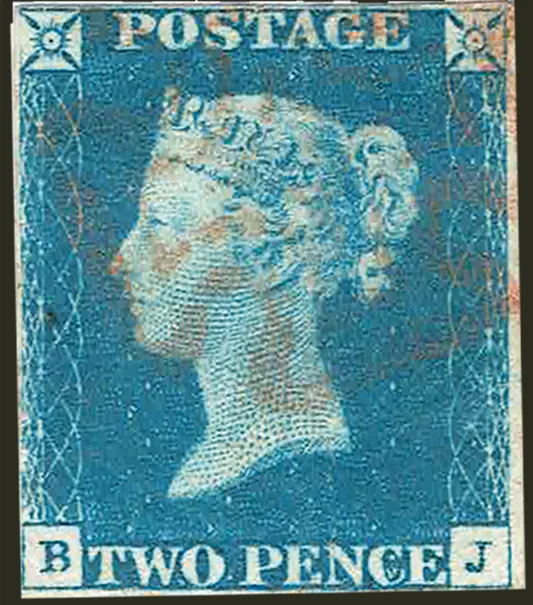 Penny Blue Penny Blue |
Legacy
The legacy of the Penny Black lives on, not only as the world’s first postage stamp but also as a pioneer of the modern postal system. A passion for stamp collecting and respect for its historical importance continue to unite collectors around the world.
The history and influence of the Penny Black reach far beyond the small piece of paper that once paid for a simple letter. The stamp became a symbol of the importance of communication and the flow of information in society, and of how technological innovation can transform everyday life.
 Penny Red Penny Red |
Collector value
The Penny Black is highly sought after by philatelists today. Although millions were printed, the number surviving in exceptional condition is limited. Value depends on factors including condition, cancellation and whether the stamp remains on cover or on a piece. Poorer used examples with one or more margins cut into can be bought for around 25,000–30,000 forints, while used examples with complete margins on all four sides are more valuable and begin at around 50,000 forints. Prices rise further for stamps on piece or on cover. At the upper end, multiples and unused examples can reach extremely high prices.
There are several reasons for the Penny Black’s popularity:
1. Innovation: The Penny Black was the first stamp to allow senders to prepay postage. This innovation revolutionised the postal system and made correspondence easier.
2. Accessibility: The uniform one-penny rate made postal services available to a much broader section of society, not only the wealthier classes.
3. Historical significance: As the world’s first officially issued postage stamp, the Penny Black is an important historical object symbolising the development of postal communication.
4. Collector value: The Penny Black occupies a special place among collectors because of its historical importance and strong collector appeal. Nevertheless, thanks to the millions originally printed, average-quality examples remain within reach of many collectors.
5. Design: Its simple yet elegant design featuring the profile of Queen Victoria remains highly attractive to collectors.
Together, these factors have contributed to the Penny Black’s fame and popularity both within philately and beyond.
 1990 – 150 Years of the Postage Stamp, souvenir sheet (Hungary) 1990 – 150 Years of the Postage Stamp, souvenir sheet (Hungary) |