
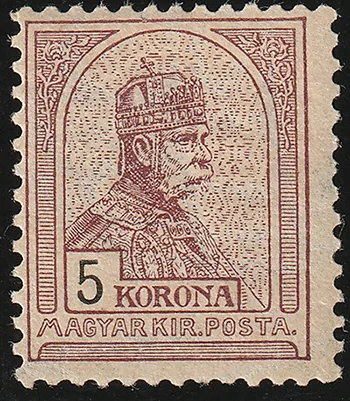
In Hungary, the korona and fillér replaced the forint and krajcár in 1900, so the Royal Hungarian Post also had to replace its earlier Krajcár stamps. People probably did not mind: by then they had been looking at essentially the same stamps for 26 years and were getting a little tired of them. The new issues are known as the Turul series after the symbol appearing on the fillér values, while the korona denominations depict Emperor Franz Joseph I.
People had no idea that they would be looking at these designs for another 15 years. Catalogues distinguish five or six different Turul issues, and the same designs were also reused for another three series.
The image shows the highest value of the 1904 issue, the 5-korona stamp.
How can the different series be distinguished easily when they all look almost identical? Why, to my great regret, can the stamp in the picture not be called mint never hinged even though it has no cancellation? Were the Krajcár stamps really boring? And how much is a stamp actually worth?
If you want the answers or the subject interests you, follow the page. I will be back soon.
If your friends might also be interested, share it with them!
Until then, get those stamp albums out and show someone what you have!